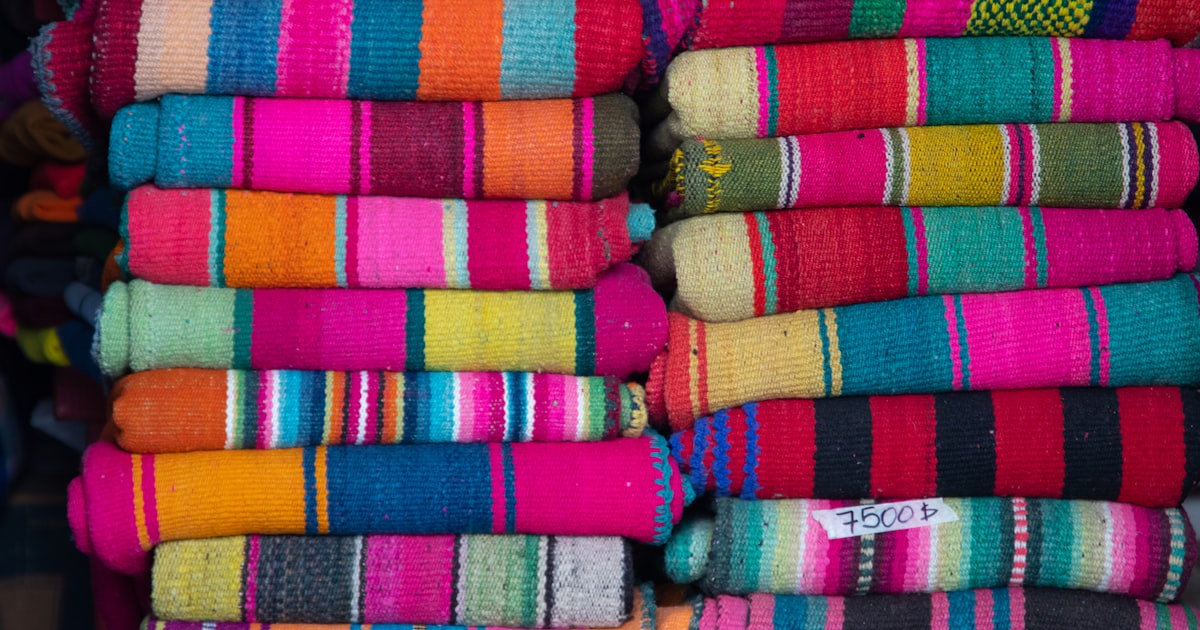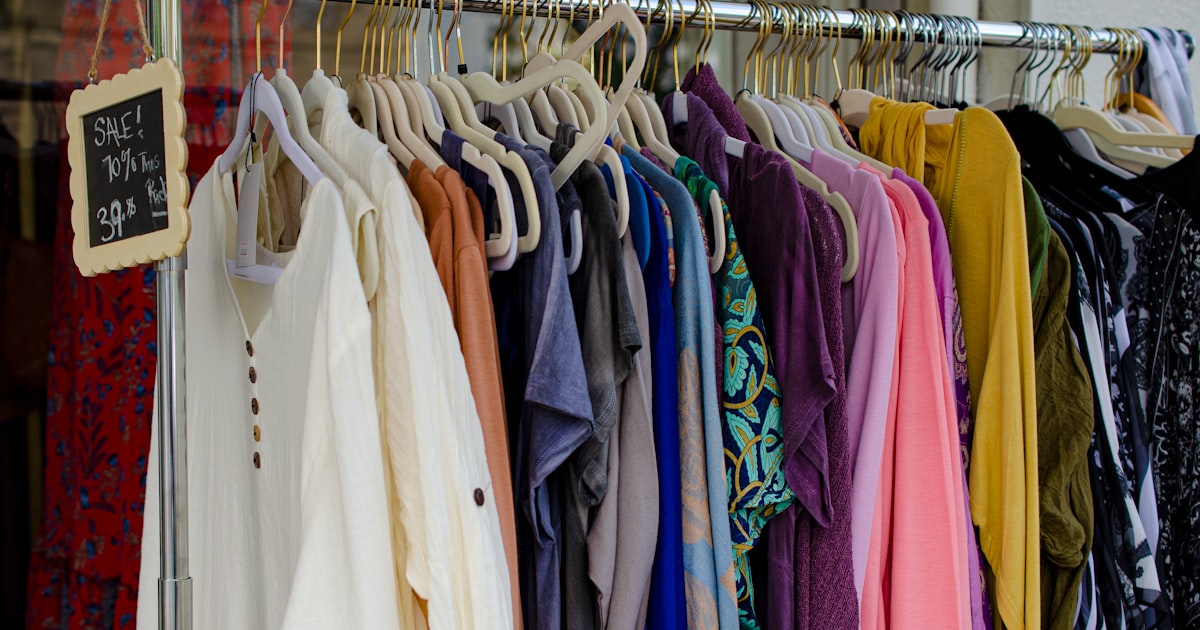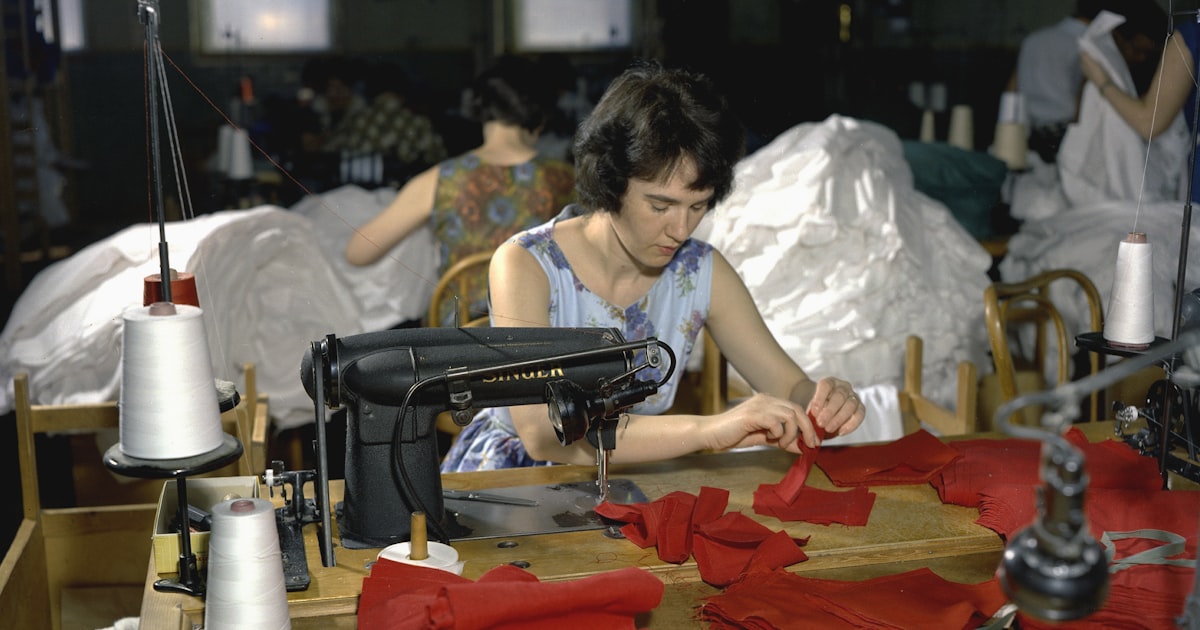

“How long do you think this will last?” my grandmother used to ask before buying anything, holding the fabric between thumb and forefinger as if she could tell from the weight alone. She probably could. She was born in 1923 and grew up in a household where clothes were repaired three or four times before being repurposed as quilt backing and finally, decades later, ripped into rags. Her instinctive cost calculation was not “how cheap is this” but “how many years per euro?” That mental model has taken nearly a century to filter back into mainstream wardrobes, but it is finally returning, sometimes under the slightly self-conscious banner of repair culture.
This piece looks at why mending has resurfaced as both a practical skill and a small but expanding economic sector, what the major techniques are (Western darning, Japanese sashiko, machine reweaving, hidden invisible repair), where to find a good repair service if you do not want to learn, and which brands now offer free or subsidised repairs as standard.
The economic case: why repair is suddenly worth it
For thirty years, the global retail price of clothing fell faster than wages, which made replacement cheaper than repair. That trend has reversed since 2021. Cotton prices rose almost 90 percent between 2020 and 2022 according to International Cotton Advisory Committee data, freight costs spiked during the pandemic, and the European Commission’s coming Extended Producer Responsibility rules will internalise some of the disposal cost into retail prices from 2025 onwards. The simple maths of replacement now favours repair for any garment originally costing more than roughly thirty euros.
The Ellen MacArthur Foundation has calculated that doubling the wear-life of a single garment cuts its lifetime emissions by about 44 percent. That is a larger climate dividend than switching from conventional to organic cotton, and considerably larger than switching to recycled polyester for any item that is washed regularly.
Visible versus invisible mending
Mending traditions split broadly into two philosophies. Western European darning evolved as invisible repair: the goal was to make the wear point disappear, ideally so well that the garment looked unworn. Skilled professional darning of a wool jumper takes between thirty and ninety minutes and can produce a result that is genuinely undetectable at arm’s length.
Japanese sashiko, originally a peasant technique from the Edo period, took the opposite view. The repair was emphasised, often with white or contrasting cotton thread laid in geometric grid patterns over indigo cotton or hemp. The technique reinforces the surrounding fabric while making no attempt to hide the original tear. In recent years sashiko-style repair has become popular in Europe and North America, partly through the widely-shared work of practitioners such as Hikaru Noguchi, whose darning books have sold strongly across translation editions.
Boro: the case for layered repair
Boro, the Japanese tradition of layering patches of indigo cotton over each other across decades, produces some of the most visually striking repaired garments in textile history. Original boro pieces from the eighteenth and nineteenth centuries are now collected by major museums, including the Amuse Museum archive in Tokyo. Modern wearers can adopt the principle without the historical weight: a hemp work jacket, repaired three or four times over a decade with patches of indigo scrap, becomes more interesting rather than less.
The four repairs everyone should know
Most adult wardrobes need only a small repertoire of techniques to handle ninety percent of typical wear-and-tear. Each can be learned in roughly two hours of practice.
Knit darning for wool jumpers
Elbow holes in lambswool jumpers respond well to Swiss darning, also called duplicate stitch, where matching wool yarn is woven over the existing knit structure to rebuild it. A wooden mushroom or darning egg provides the curved support. With matching yarn and decent light, an elbow hole can be repaired in under thirty minutes and become invisible after one wash.
Patch repair for trousers
Knee blowouts on jeans and work trousers are best handled with a denim patch ironed or stitched on the inside, then reinforced with sashiko grid stitching from outside. Hemp denim patches absorb indigo dye over time and integrate visually with the original fabric.
Seam repair
Most “broken” garments are simply seam failures, where stitching has come loose. A whip stitch from inside, with thread matching the original colour, restores them in under ten minutes and is the single most useful repair to learn.
Button replacement
Strange that this is uncommon, but most adults cannot reliably sew on a button. The technique takes about three minutes per button once learned, requires only thread and a needle, and prevents an entire garment from being treated as broken.
Professional repair: where to send what you cannot fix
For garments worth saving but beyond home-repair scope, professional services have expanded across most European cities. The Seam in London and Sojo in the UK both run app-based repair networks connecting customers to vetted seamstresses. Repair Rebels operates a similar model in Germany. In Italy, Atelier Riforma in Turin combines professional repair with redesign and resale. Repair pricing typically ranges from eight to forty euros per repair, which is well below replacement cost for any quality garment.
Specialist services exist for harder problems. Re-weaving (also called French weaving) rebuilds the actual woven fabric structure of a hole using threads pulled from a hidden seam allowance. The technique is rare but several specialists in Milan, Paris and London still practise it, primarily for high-end suiting and outerwear.

Brands offering free or subsidised repairs
Repair-as-service has become a measurable competitive feature among brands that want to demonstrate durability rather than perform it. The most established programmes:
- Patagonia Worn Wear: free repairs for Patagonia products in most countries, with a touring repair van across Europe each summer. The company has reported more than 100,000 European repairs since 2017.
- Nudie Jeans: free in-store denim repair at any of its repair shops worldwide, which currently number roughly thirty in Europe.
- Filson: lifetime guarantee with subsidised repairs at the company’s Seattle facility.
- Iron Heart: free repairs on its denim products for the original owner.
- Veja: in-store cleaning and repair stations in Berlin, Bordeaux, Paris and Madrid.
The civic side: repair vouchers and right-to-repair
Several European countries have begun subsidising clothing repair as a public-policy lever. France introduced a bonus réparation for textiles in late 2023, offering between six and twenty-five euros per repair, redeemable at certified menders. Sweden cut VAT on repair services from 25 to 12 percent in 2017, then to 6 percent in 2022. Austria and parts of Germany run regional repair-voucher schemes. The European Right to Repair coalition has campaigned to extend these schemes across the EU as part of the Circular Economy Action Plan.
Repair as cultural practice
Beyond economics, the social register of repaired clothing has shifted. A patched elbow on a jumper, a sashiko grid across a torn knee, a darned shirt cuff — these are no longer signs of poverty. They are signs that the wearer is choosing duration over novelty, which has become a quiet status marker in certain circles. Several younger Italian and French designers — including the Florentine atelier Patrizio Anastasi and the Lyon-based studio Maison Standards — now sell garments with visible repairs as part of the original design, sold at full price.
The deeper cultural shift is harder to measure but perhaps more durable. When a garment is repaired three or four times over a decade, the relationship between wearer and clothing changes from disposable to companionable. The pieces accumulate stories: where the tear came from, who repaired it, which season it survived. Whether that registers as nostalgia or as practical wisdom probably depends on the reader, but the trend lines suggest it is happening regardless.
Where to start tomorrow
Buy a basic mending kit (needles, embroidery scissors, a wooden darning mushroom, white and black cotton thread, a small skein of matching wool yarn for any jumper you own). Identify three garments in your wardrobe with small failures. Repair the easiest one first, ideally a seam or a button, before attempting a darning project. The skill curve is short. Most people who attempt three repairs become reasonably competent at all four basic techniques.
The repair toolkit, in detail
For readers building a kit from scratch, the basic equipment costs between 30 and 80 euros and lasts essentially forever. The minimum useful set: a packet of mixed sharps needles (sizes 5 to 10), a packet of darning needles (longer eye, thicker shaft), embroidery scissors, a wooden darning mushroom or egg, a thimble, a small magnifying lamp if your eyesight requires it, and a tin of mixed cotton thread covering at least black, white, navy, beige and grey. For wool repairs, add small skeins of cream, charcoal and undyed brown lambswool yarn from a brand such as Jamieson’s of Shetland or Rauma Strikkegarn, both of which sell single small balls for under five euros.
For sashiko, an authentic kit adds a single sashiko needle (longer and stiffer than a Western darning needle), white sashiko cotton thread, and a small leather palm thimble. The Japanese supplier Olympus and the German distributor Kabuki Textiles both ship across Europe at reasonable cost. A sashiko grid template (a small piece of cardboard with a regular dot pattern) speeds beginner work and is worth the two euros.
Decision criteria: when to repair, when to retire
Not every garment is worth repairing, and a clear decision rule prevents both wasted effort on the wrong items and the premature retirement of perfectly fixable pieces. The criteria below cover roughly 95 percent of typical decisions.
- Original quality. A garment built from natural fibre with reinforced seams is worth repairing through several iterations. A polyester blouse from a fast-fashion supplier is rarely worth the time, because the fabric will fail again at a different point within months.
- Type of failure. Seam failures, button losses and small holes are essentially always repairable. Fabric pilling, surface fading and underarm yellowing are wear conditions, not failures, and call for cleaning rather than repair. Structural collapse — a fabric that has thinned to translucency across an entire panel — is a sign that the garment has reached the end of its useful life.
- Sentimental or material value. A grandfather’s wool overcoat, an expensive tailored jacket, or a hand-knitted jumper merits professional repair even at substantial cost. The Italian rule of thumb is that any repair under one-third of replacement value is economically rational.
- Visible-mending suitability. Some garments suit visible mending; others do not. Casual denim, work trousers, and rough cotton or linen pieces accept visible patches gracefully. Suiting fabrics, smooth wool and silk garments rarely do, and require either invisible repair or none.
Misconceptions about modern repair
Several common assumptions get repair culture slightly wrong. The first is that repair is inherently slow. A button takes three minutes, a seam takes ten, a small darn takes thirty. The total time investment for a year of household garment maintenance is well under twenty hours for most adults — meaningfully less than the time spent shopping for the replacements that the repairs render unnecessary.
The second is that repaired clothing always looks worse than new. Visible mending in particular has become an aesthetic in its own right, championed by practitioners such as Tom of Holland in Brighton and Celia Pym in London, both of whom have exhibited their work at the Victoria and Albert Museum. The third misconception is that professional repair is too expensive. The average repair invoice across the UK Sojo network in 2024 was 18 pounds; across the German Repair Rebels network, 22 euros. Both figures are an order of magnitude below the replacement cost of a competent garment.
Right to repair beyond clothing
The clothing repair revival sits inside a broader policy shift. The European Parliament passed the Right to Repair Directive in spring 2024, which now requires manufacturers of household appliances and electronics to make spare parts and repair manuals available to independent menders. Although the textile sector is not yet covered by the same directive, the Ecodesign for Sustainable Products Regulation will introduce repairability requirements for clothing categories from 2027 onwards. The right-to-repair movement has consistently treated textiles as the next major category, partly because of the climate dividend and partly because of the cultural acceptance that repair is reasonable.
Beyond formal policy, civic repair networks have multiplied. The Repair Café movement, founded in Amsterdam in 2009 by Martine Postma, now operates more than 2,500 monthly events across 35 countries, several of which include dedicated textile-repair stations alongside electronics and bicycles. Local libraries in cities including Helsinki, Berlin and Glasgow have begun lending sewing machines, mending kits and instructional manuals on the same model as book lending.
The mending traditions of specific cultures
Several specific cultural traditions of mending deserve attention beyond the well-known sashiko and boro examples. The Indian tradition of rafoogari, particularly associated with Kashmir and the broader Himalayan region, involves an elaborate weaving-based repair technique used historically for valuable shawls and carpets. A skilled rafoogar can rebuild damaged Pashmina or carpet structure invisibly, with the repaired area indistinguishable from the original after completion. The technique requires years of apprenticeship and remains practised by a relatively small group of specialists primarily in Srinagar and the surrounding region.
The Tibetan tradition of patched and repaired robes, particularly within Buddhist monastic communities, has produced its own aesthetic with substantial cultural meaning. The patched robes were specifically symbolic of monastic detachment from material acquisition; a robe with substantial visible repair was preferred to a new replacement, with the repairs themselves becoming part of the spiritual practice. The tradition continues in some Tibetan and broader Himalayan Buddhist communities.
The Korean tradition of jogakbo patchwork, while not strictly a repair tradition, draws on similar principles of rebuilding usefulness from fragments. The colourful patchwork wrapping cloths, made from textile remnants too small for other uses, represent a Korean approach to fragment integration that has aesthetic and practical parallels with European visible mending traditions.
The Scandinavian tradition of nålbinding (a precursor to knitting that produces interlocked-loop fabric) has its own distinctive repair aesthetic, with damaged areas rebuilt through additional looped construction that is visible but textually integrated with the original work. Several Nordic textile museums maintain collections of nålbinding garments showing repairs across centuries of use.
The repair economy in numbers
The clothing repair sector has grown into a measurable economic category over the past decade. The 2024 European Environmental Bureau report on textile repair estimated total European spending on commercial clothing repair services at approximately 1.2 billion EUR annually, with growth running at roughly 12 to 15 percent per year. The UK Sojo platform alone has handled more than 250,000 repairs since its 2019 founding, with the Repair Rebels network in Germany operating at similar scale.
The employment effects are similarly meaningful. The European Repair Forum estimates that the repair sector supports approximately 35,000 to 50,000 jobs across the EU, with particular concentration in countries that have implemented repair voucher programmes (France, Sweden, parts of Germany and Austria). The jobs are typically modestly paid but provide meaningful skilled employment in sectors that have historically faced declining traditional craftwork demand.
The carbon impact of expanded repair has been studied in several recent assessments. The 2023 Ellen MacArthur Foundation analysis projected that doubling European clothing repair rates from current levels could reduce textile sector emissions by approximately 4 to 6 percent across the continent — meaningful but not transformative. Combined with parallel reductions from longer wear-life, increased fibre quality and reduced volume, repair contributes to a broader climate strategy without being a standalone solution.
For deeper exploration, our notes on vintage and upcycling include long-form pieces on individual menders, while our guardaroba consapevole archive covers the broader case for slower wardrobes. We also maintain a thread on local repair workshops across Italy, with venue listings updated each season. The UNESCO Intangible Cultural Heritage register lists several textile-repair traditions, including Japanese boro and Korean jogakbo, which provide useful historical context for the current revival.
This article is for informational purposes and reflects publicly available data and personal practice; check brand and government voucher programme details directly, since terms change.